
Feb 12, 2026
Captain Startup
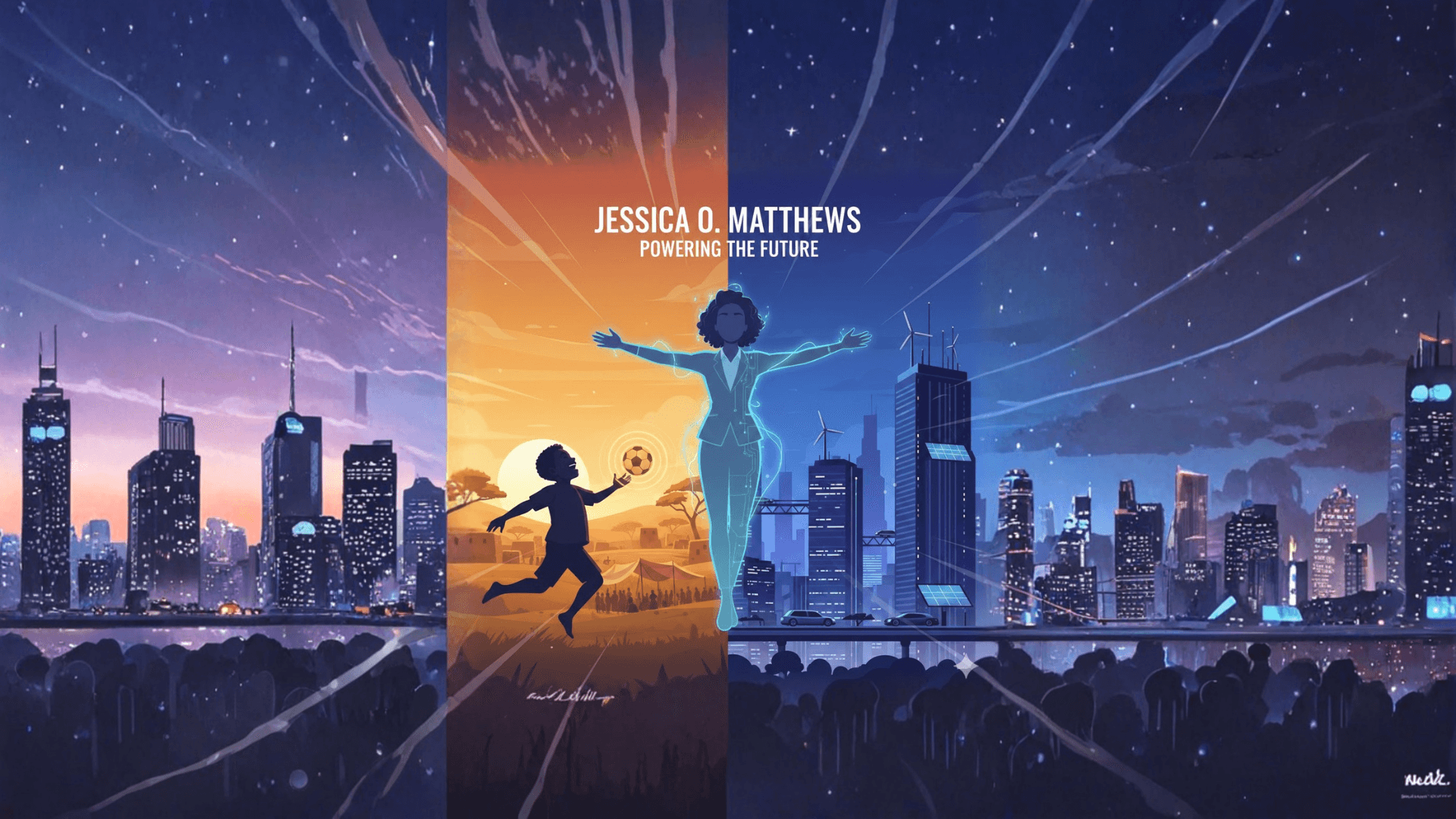
Chapter 1: Early Roots – A Dual Identity Between Two Worlds
Jessica Omonigho Matthews was born on February 13, 1988, in the United States to Nigerian immigrant parents who had built a life between two worlds. Growing up in Poughkeepsie, New York, Jessica held dual citizenship in the United States and Nigeria, a status that would profoundly shape her worldview and entrepreneurial mission. Her father owned several businesses in the town and city of Poughkeepsie, exposing young Jessica to entrepreneurial thinking from an early age.
The Matthews household was infused with Nigerian culture, values, and an awareness of the stark contrasts between life in America and the challenges faced by relatives back home in Nigeria. Jessica attended Our Lady of Lourdes High School, a Catholic institution that neighbored the Vassar Farm. Poughkeepsie, on paper, had everything—multiple higher education institutions, a train connecting directly to New York City, and people who were both very much local and global in their perspective. Yet Jessica felt a tension. "When I was growing up, I knew I had my roots here, but I felt like my wings would only come if I left," she later reflected.
From childhood, Jessica dreamed of becoming an inventor. She was naturally curious about how things worked, drawn to science and engineering concepts, and possessed a problem-solving mindset that sought creative solutions to everyday challenges. She excelled academically, eventually earning admission to Harvard University, one of the most prestigious institutions in the world, where she would major in psychology and economics. Little did she know that a family wedding halfway across the world would ignite the invention that would define her life.
Chapter 2: The Wedding That Changed Everything – Choking on Diesel Fumes in Nigeria
In 2008, during her junior year at Harvard, 19-year-old Jessica traveled to Nigeria to attend her aunt's wedding. It was meant to be a celebration—a joyous family gathering filled with music, dancing, and the warmth of extended family connections. But what should have been a beautiful memory became the catalyst for Jessica's life mission.
As is common throughout Nigeria, regardless of socioeconomic status, the power went out multiple times during the celebration. This was simply a fact of life in a country where the electrical grid was notoriously unreliable. Several times a day, Nigerians could expect to lose power. To keep the wedding festivities going, the family brought out diesel generators, the ubiquitous backup power source used across the country.
Jessica remembered feeling like she was choking. The thick, acrid smoke from the diesel generators filled the outdoor space, making it hard to breathe. The fumes were hazardous, containing toxic chemicals and particulate matter linked to respiratory diseases, cancer, and premature death. Bothered by the smoke, Jessica mentioned it to her relatives, expecting shared concern. Their response shocked her. "Don't worry, you'll get used to it," they told her matter-of-factly.
"I remember this bothered me so much because it was them telling me to essentially get used to dying," Jessica recalled years later. "But what was even more saddening for me was that it was very clear that's what they had gotten used to doing". This acceptance of a slow, poisonous status quo haunted Jessica. Her relatives, her friends, millions of Nigerians and people across the developing world had normalized exposure to deadly fumes simply because there appeared to be no alternative.
Jessica refused to accept this. She decided right then that she would find a cleaner, safer, more sustainable way to generate electricity—one that didn't require people to choose between darkness and poisoning themselves.
Chapter 3: The Harvard Engineering Assignment – Turning Play into Power
Returning to Harvard after the wedding, Jessica couldn't shake the image of her relatives breathing in toxic generator fumes. She began researching energy solutions, exploring renewable technologies, and thinking creatively about how to harness power in environments where traditional electrical grids were unreliable or nonexistent.
The breakthrough came through an engineering class assignment. In 2008, Jessica and her Harvard classmate Julia Silverman were tasked with creating an innovative solution to a real-world problem. Jessica knew exactly what problem she wanted to solve. Nigeria, like much of sub-Saharan Africa, was passionate about soccer. Children played in streets, fields, and vacant lots, kicking balls for hours every day. What if that kinetic energy—the energy of motion—could be captured, stored, and converted into usable electricity?
Jessica and Julia invented the SOCCKET, a revolutionary energy-generating soccer ball. The technology was elegantly simple yet ingenious. As the ball was kicked and rolled during play, an internal mechanism captured the kinetic energy and stored it in a battery. After just 30 minutes of play, the SOCCKET could generate enough electricity to power a small attachable LED light for three hours. Children playing soccer during the day could create the reading light they needed to do homework after dark, in communities where reliable electricity was a luxury.
The invention was transformative. It required no fossil fuels, no toxic generators, no connection to an electrical grid. It was entirely self-sufficient, renewable, and powered by the joy of play. At just 19 years old, Jessica had created a technology that could literally bring light to millions living in energy poverty.
Chapter 4: Founding Uncharted Power – From Classroom Project to Social Enterprise
Jessica and Julia didn't just submit their project for a grade and move on. They recognized the profound real-world potential of what they had created. In May 2011, shortly after graduating from Harvard with her bachelor's degree, Jessica co-founded Uncharted Power to develop and distribute the SOCCKET and other motion-based renewable energy products. Julia Silverman was her co-founder, but Jessica assumed the role of CEO, taking responsibility for turning the invention into a sustainable business.
The company initially launched under the name Uncharted Play, reflecting its origin in the concept of play as a tool for social invention. The founding mission was clear: decentralize and democratize power, creating access to renewable energy all around the world. Jessica wanted to show the world that play could be a tangible tool for inspiring social invention and solving energy poverty.
After graduating from college in 2010, Jessica took a full-time job at CrowdTap, a crowdfunding company, to support herself financially while continuing to develop Uncharted Power on the side. But the pull of her invention was too strong. In 2011, she left her stable job to work on Uncharted Power full-time, a leap of faith that required unwavering belief in her mission.
Jessica initially raised funds through Kickstarter, tapping into the growing crowdfunding movement to validate market interest and secure initial capital. She then utilized convertible debt to continue funding operations. These were the scrappy, uncertain early days of entrepreneurship—pitching to skeptical investors, managing cash flow on a shoestring budget, and constantly iterating on product design to improve efficiency and durability.
Chapter 5: Presidential Recognition and Early Validation
Jessica's invention and mission caught the attention of powerful allies. In 2011, just months after founding Uncharted Power, Fortune magazine named her one of its "10 Most Powerful Women Entrepreneurs". That same year, she presented the SOCCKET at the Clinton Global Initiative University, a prestigious platform convening young leaders committed to solving global challenges.
In 2012, Jessica received an extraordinary honor. President Barack Obama invited her to the White House to represent small companies for the signing of the America Invents Act, landmark legislation reforming the U.S. patent system. At just 24 years old, Jessica stood alongside the President of the United States, symbolizing the future of American innovation—young, diverse, mission-driven, and solving problems that affected billions globally.
In 2013, President Obama invited Jessica again, this time to accompany him on his official trip to Tanzania, where he highlighted the SOCCKET as an example of American innovation addressing African development challenges. For Jessica, these moments weren't just personal accolades—they were validation that her mission resonated at the highest levels of global leadership.
Uncharted Power also developed the Pulse, a jump rope that stored energy in a manner similar to the SOCCKET. Fifteen minutes of jumping rope could generate three hours of LED light power. The company was building a portfolio of motion-based renewable energy products, all designed to be accessible, affordable, and empowering for communities living without reliable electricity.
Chapter 6: Expanding the Product Line and Scaling Impact
While the SOCCKET captured global imagination and media attention, Jessica knew that toy-sized solutions wouldn't solve infrastructure-scale energy poverty. She began envisioning larger applications for motion-based renewable energy technology. What if the same principles powering a soccer ball could power streetlights, Wi-Fi hotspots, or entire buildings?
Uncharted Power evolved into a renewable energy company creating microgenerator energy systems that could be scaled to power large infrastructure systems. Jessica's team developed technology designed to be integrated into roads, sidewalks, and buildings, transforming vehicular and pedestrian traffic into usable electricity. Partners implementing Uncharted Power's systems could save 20 percent or more on their electricity bills while generating clean, renewable power. Over 25,000 pounds of kinetic energy were being captured and converted daily.
"I really got into the energy space not necessarily to solve energy problems but because it was intriguing to me that no one thought there could be a solution," Jessica explained. "With my company, I wanted to see how far we could push this so that people could see that they have more agency and we could do more than the status quo".
In 2015, Fortune magazine named Jessica one of its "Most Promising Women Entrepreneurs," recognizing her trajectory from college inventor to infrastructure innovator. She continued her education, earning an MBA from Harvard Business School, deepening her understanding of scaling businesses and raising institutional capital.
Chapter 7: The Historic Series A – Breaking Barriers as a Black Female Founder
In 2016, Jessica achieved a milestone that reverberated throughout the venture capital and entrepreneurship ecosystems. She raised a $7 million Series A round for Uncharted Power—at the time, the largest Series A round ever raised by a Black female founder in history. This wasn't just a personal achievement; it was a statement about the systemic barriers facing Black women entrepreneurs and proof that those barriers could be broken.
To celebrate this historic funding round, Jessica was selected to ring the NASDAQ opening ceremony bell, representing all Forbes 30 Under 30 alumni. Standing on the NASDAQ floor, looking out at the cameras and traders, Jessica symbolized possibility—a young Black woman from Poughkeepsie who had invented a technology at 19, built a company at 22, and by 26 was raising millions to transform global energy infrastructure.
With the Series A capital, Jessica rebranded the company from Uncharted Play to Uncharted Power, signaling the strategic pivot from consumer products to infrastructure solutions. She moved the company's headquarters to Harlem, New York, deliberately choosing to build outside Silicon Valley. "We're not trying to be the next Silicon Valley company," Jessica explained. She wanted to build what she called the "anti-Silicon Valley energy startup"—one rooted in community, diversity, and solving problems for those most marginalized by traditional economic systems.
Jessica's leadership style emphasized hiring slowly and building a nimble internal team that could pivot and adapt as the company evolved. She watched peers over-hire during fundraising cycles only to face painful layoffs later. By maintaining discipline around headcount and focusing on high-impact roles, Uncharted Power remained agile and resilient.
Chapter 8: From Soccer Balls to Smart Cities – The Infrastructure Transformation
By the late 2010s, Uncharted Power had fundamentally transformed its business model. The company now focused on creating solutions that enable economies of scale to deploy and manage smart, sustainable cities. Jessica's vision expanded from bringing light to children doing homework to reimagining urban infrastructure entirely.
Uncharted Power developed technology transforming the ground beneath us into an industrial IoT (Internet of Things) platform for streamlining the integration, deployment, and management of critical infrastructures like power lines, broadband, sidewalks, and water pipes. Their solutions demonstrated an alternative to the current grid system—one that was modular, clean, and much more easily installed than existing infrastructure.
The technology had applications across multiple industries. Utility companies could modernize aging grids. Land developers could integrate renewable energy into new construction from the ground up. Community developers could bring electricity to underserved neighborhoods. Telecom companies rolling out 5G networks could power infrastructure sustainably. IoT companies could deploy sensors without reliance on traditional power sources.
By 2018, Uncharted Power was providing high-quality solutions to 25 percent of the Fortune 50 companies. Jessica had succeeded in scaling from a classroom invention to an enterprise technology platform serving the world's largest corporations. Yet she never lost sight of her original mission—bringing clean, accessible energy to communities that needed it most.
Chapter 9: Becoming a Thought Leader and Advisor to Government
Jessica's expertise and accomplishments elevated her to national prominence as a thought leader on climate resiliency, renewable energy, and sustainable infrastructure. She was named to Harvard University's Scientist of the Year, an extraordinary honor recognizing her contributions to applied science and social impact. She received the Muhammad Ali Humanitarian Award for her work bringing energy access to underserved communities.
In 2021, U.S. Secretary of Energy Jennifer Granholm appointed Jessica to the Electricity Advisory Committee, making her an official advisor to the Department of Energy on modernizing America's energy infrastructure. This appointment placed Jessica at the table with policymakers, utility executives, and engineers shaping the future of the nation's electrical grid. Her unique perspective—bridging grassroots innovation, venture-backed entrepreneurship, and on-the-ground experience in energy-poor communities—made her an invaluable voice in these critical conversations.
Jessica became a sought-after speaker, presenting at conferences, universities, and forums worldwide. She appeared on numerous media platforms sharing her journey and advocating for inclusive innovation. As an inventor, she holds over 12 patents, a testament to her continued creativity and technical contributions to renewable energy technology.
Chapter 10: Mission and Legacy – Democratizing Power for All
Today, Uncharted Power continues to push boundaries under Jessica's leadership. The company's newest innovations use AI-powered photo analysis to assess energy cost savings in homes around the world. This technology democratizes energy audits, making them accessible to homeowners who couldn't previously afford professional assessments. It's another example of Jessica's core philosophy: using technology to level the playing field and give everyone, regardless of wealth or geography, agency over their energy use.
Jessica's work has inspired countless young inventors, particularly young women and people of color who see themselves reflected in her success. She frequently speaks about the importance of representation, noting that seeing someone who looks like you achieving in STEM fields fundamentally changes what young people believe is possible for themselves.
Her journey from a 19-year-old Harvard student bothered by diesel fumes to a CEO advising the U.S. Department of Energy embodies the power of refusing to accept harmful status quos. Jessica didn't just invent a better mousetrap—she reimagined entire systems, proving that renewable energy could be decentralized, democratized, and accessible to all.
Epilogue: Lessons in Innovation – When Play Becomes Purpose
Jessica O. Matthews' story teaches profound lessons about the intersection of personal experience, technical innovation, and social entrepreneurship. Her Nigerian aunt's wedding wasn't just a family event—it was a window into the daily reality of billions living with unreliable electricity and toxic backup power sources. Rather than accepting what her relatives had normalized, Jessica chose to act.
Her invention of the SOCCKET at age 19 proves that transformative innovation can come from unexpected places—students in college classrooms, not just corporate research labs. Her pivot from consumer products to infrastructure solutions demonstrates strategic thinking and willingness to follow market signals toward greater impact. Her historic fundraising achievements as a Black woman in venture capital opened doors for founders who followed.
Most importantly, Jessica's work embodies a philosophy of empowerment. She didn't create aid programs giving people light—she created technologies enabling people to generate their own power through their own motion, their own play, their own activity. This distinction matters. It's the difference between charity and dignity, dependence and agency.
From choking on diesel fumes to revolutionizing renewable energy infrastructure, from a Harvard engineering class to advising the U.S. Secretary of Energy, Jessica O. Matthews proves that the most powerful innovations emerge not from comfort but from witnessing suffering and refusing to look away. Her story continues to unfold, lighting the way—quite literally—for millions around the world.
Verification Sources:
Wikipedia: Jessica O. Matthews
Forbes articles
Business Insider profiles
The Lemelson Foundation
Nasdaq Center
Black PR Wire
Vassar Miscellany News
Smithsonian interviews
Fast Company
Culturs Magazine
Multiple verified media sources
Sources for this story: Information verified from Wikipedia, Forbes, Business Insider, The Lemelson Foundation, Nasdaq Center, Black PR Wire, Vassar Miscellany News, Smithsonian interviews, and multiple verified media profiles.

© 2025. All rights reserved. Powered by The Algorithm